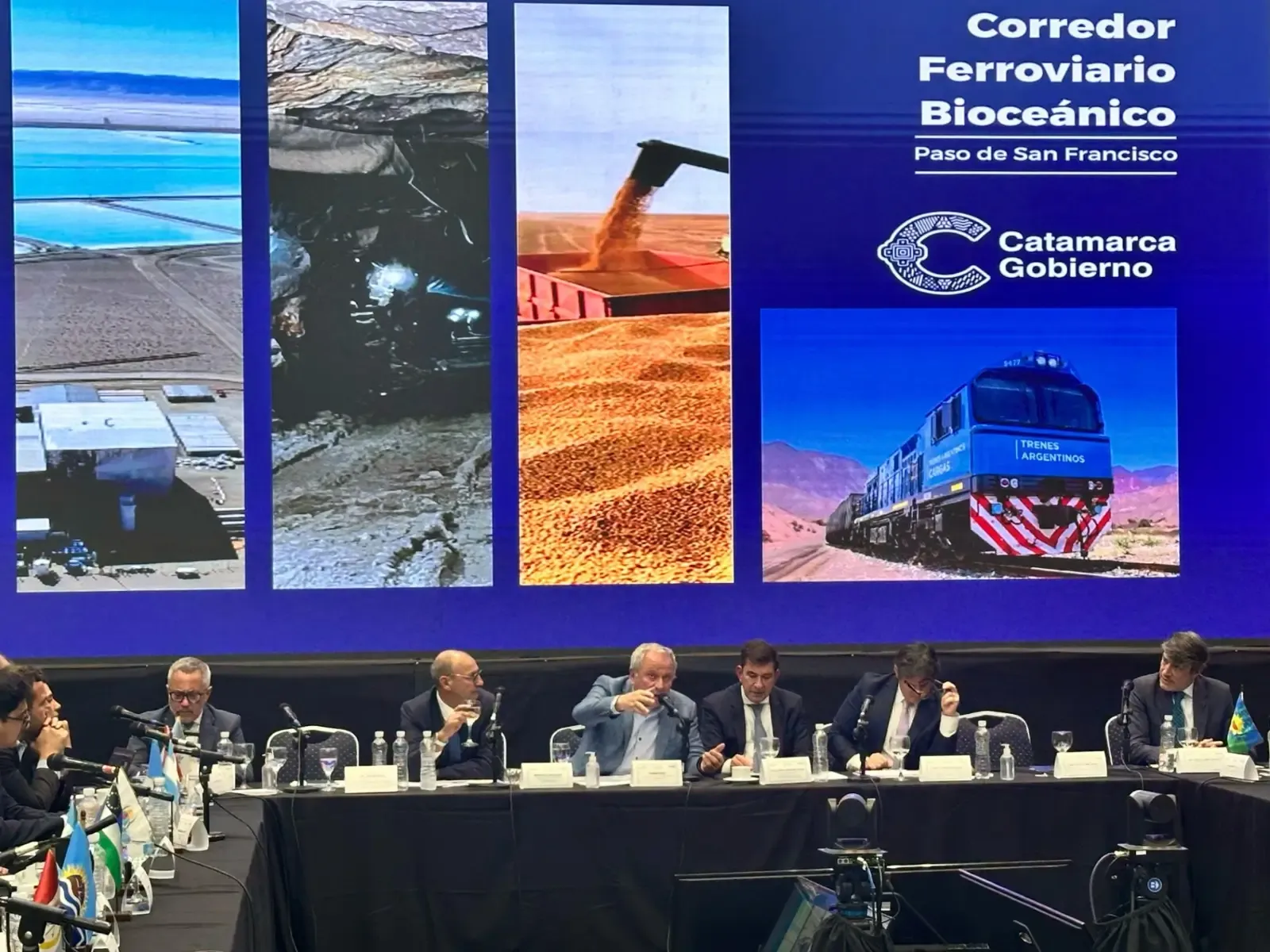
The Vice Governor of Catamarca, Rubén Dusso, presented the vision of consolidating the Bi-Oceanic Railway Corridor through the San Francisco Pass as a pillar for productive transformation, particularly for the mining industry.
By Panorama Minero
Within the framework of the 7th Plenary Meeting of the Executive Committee of the Federal Council for Foreign Affairs and International Trade, held in the city of Santiago del Estero, the Vice Governor of Catamarca, Rubén Dusso, actively participated in a forum aimed at promoting a truly federal foreign policy.
However, beyond institutional dialogue, Dusso brought with him a concrete and strategic vision: to consolidate the Bi-Oceanic Railway Corridor via the San Francisco Pass as a key axis for productive transformation, particularly in the mining sector.
The meeting —which was hosted by Santiago del Estero Governor Gerardo Zamora and Vice Governor Carlos Silva Neder — provided the ideal setting to share an integrated perspective on the challenges of internationalizing regional economies. Dusso was accompanied by Elena Herrera, Secretary of International Relations, and Ivana Lencina, Provincial Director of Foreign Affairs.
A Corridor to Boost Mining Potential and Production in the North-Central Region of Argentina
During his address, the Vice Governor outlined the core pillars of the railway project that will connect the center of the country with the Chilean Pacific, crossing through the San Francisco Pass and linking to deep-water ports in the Atacama Region, near Copiapó. This is critical infrastructure which, in Dusso’s words, “must be viewed as a strategic State investment,” as it will “enable the export of mining production to markets such as China, Japan, India, and other Asia-Pacific destinations.”
“We are facing a unique opportunity to reshape the logistics map of the country, and mining can be the driving force to support and justify that transformation,” said the Catamarca official. He emphasized that many mining projects currently facing logistical export limitations will find in this corridor an efficient, safe, and competitive route.
The project’s potential goes beyond transportation efficiency: “It brings Catamarca and Northwest Argentina closer to the heart of global trade flows, reduces operational costs, improves competitive margins, and—most importantly—creates a framework of predictability to attract new mining investments.”
Mining and Infrastructure: A Strategic Alliance
Dusso emphasized that the mining investment regime can serve as a model for structuring frameworks that encourage infrastructure financing. “Mining has shown that, with clear rules, it can support large-scale productive ventures. The same must apply to structural projects like this one: the more we work together, the more we share experiences and capabilities, the closer we will be to making this federal vision of development a reality,” he stated.